


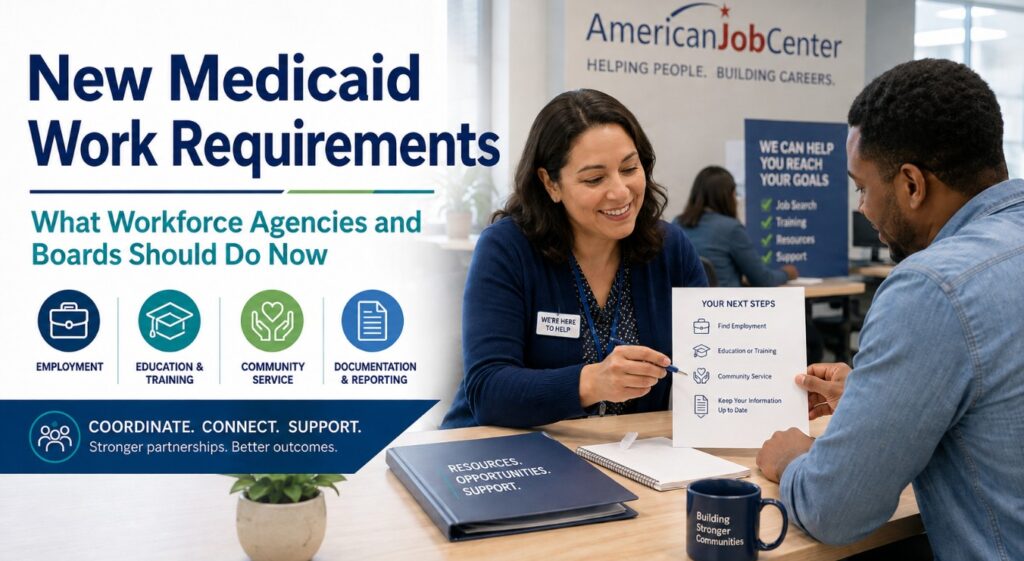
Beginning January 1, 2027, certain adults will be required to demonstrate participation in employment, education, community service, an approved work program, or a combination of qualifying activities to obtain or retain Medicaid coverage.
The policy will be administered through state Medicaid systems, but its effects are likely to extend well beyond Medicaid agencies. State workforce agencies, local workforce development boards, American Job Centers, educational institutions, community organizations, and employers may all have a role in helping individuals understand and meet the requirements.
For workforce leaders, the immediate question is not whether they support or oppose the policy. The practical question is whether their systems will be prepared when customers begin asking for assistance.
Why This Matters to the Workforce System
Affected individuals will generally need to complete at least 80 hours of qualifying activity each month. Qualifying activities may include employment, education, job training, community service, or participation in another approved program. Certain individuals will be exempt based on circumstances such as caregiving responsibilities, pregnancy, medical conditions, veteran status, or participation in substance-use treatment.
Many people subject to the requirement may already be working or participating in education. Their primary need may be help documenting that activity. Others may need assistance finding employment, increasing their work hours, enrolling in training, entering an educational program, or locating an approved community-service opportunity.
This makes workforce agencies and American Job Centers logical places for individuals to seek information and support.
A customer may arrive with a Medicaid notice rather than a traditional request for employment services. Frontline staff will need to recognize the issue, understand the workforce system’s role, and direct the individual to the appropriate resources.
The Main Challenge May Be Coordination
The new requirements will involve multiple systems that do not always share information easily. Medicaid agencies may verify eligibility, while employers, schools, training providers, workforce programs, and community organizations maintain records of participation.
Without clear coordination, individuals may be required to navigate several agencies and submit the same information more than once. They may also face difficulties correcting inaccurate records or proving that they qualify for an exemption.
Workforce boards should begin working with partner agencies to answer several operational questions:
- Which workforce activities will satisfy the requirement?
- What documentation will Medicaid agencies accept?
- Can workforce-management systems transmit participation information directly?
- Who will assist customers when records are missing or incorrect?
- How will individuals with limited digital access, transportation, language proficiency, or documentation be served?
- Which agency will provide the final answer when a customer is unsure whether the requirement applies?
These questions should be resolved before large numbers of customers begin requesting assistance.
Five Actions Workforce Boards Can Take Now
1. Establish a cross-agency planning group
Workforce boards should convene representatives from Medicaid, human services, unemployment insurance, adult education, community colleges, vocational rehabilitation, community organizations, and other relevant partners.
The group should define responsibilities, referral procedures, documentation standards, and escalation points. The goal should be a coordinated customer pathway rather than a collection of separate agency processes.
2. Estimate the likely local impact
Boards should work with state and local partners to estimate how many residents may be affected. They should also identify where those individuals live, which populations may require additional assistance, and which American Job Centers are most likely to experience increased demand.
This assessment should include staffing, call-center capacity, technology, translation services, transportation barriers, and community outreach needs.
3. Prepare frontline staff
Workforce professionals do not need to become Medicaid eligibility specialists. They do need enough information to recognize the issue and provide accurate guidance.
Staff training should explain who may be affected, which activities may qualify, where customers can obtain an eligibility determination, and how workforce services can help. Staff should also receive a clear referral directory and a process for escalating complex cases.
4. Create simple customer materials
Customers will need straightforward answers to three questions:
- Does the requirement apply to me?
- What activities count?
- How do I prove that I completed them?
Agencies should avoid creating lengthy explanations filled with program terminology. Materials should use plain language, be available in multiple formats and languages, and clearly distinguish workforce assistance from Medicaid eligibility decisions.
5. Review data and documentation systems
Workforce agencies should determine whether their existing systems can document hours, attendance, enrollment, training participation, and other qualifying activities in a form that Medicaid agencies can use.
Where possible, agencies should reduce the need for customers to carry records between programs. Data-sharing arrangements should protect privacy while making verification as simple and reliable as possible.
An Opportunity to Connect Customers With Longer-Term Value
Some individuals will initially contact the workforce system because they need to satisfy a requirement. That contact can also create an opportunity to connect them with services that support longer-term employment and economic stability.
A request for documentation may lead to help with job search, occupational training, credentials, career planning, supportive services, or advancement into better employment. The goal should not be limited to recording participation hours when the workforce system can also help customers make meaningful progress.
This will require careful customer service. Individuals should be treated as people seeking assistance, not merely as compliance cases.
Prepare Before Notices Become Problems
The implementation timeline provides workforce agencies and boards with a limited preparation period. Waiting until customers begin arriving with notices could lead to inconsistent answers, unnecessary referrals, administrative errors, and avoidable loss of coverage.
Workforce leaders should begin planning now, even where state implementation details are still developing. Early preparation can focus on relationships, staff readiness, customer communication, system capacity, and the questions that must be resolved.
The most useful planning question is simple:
When a customer enters an American Job Center with a Medicaid notice, will staff know where to begin, what assistance to provide, and how to help the customer take the next step?