


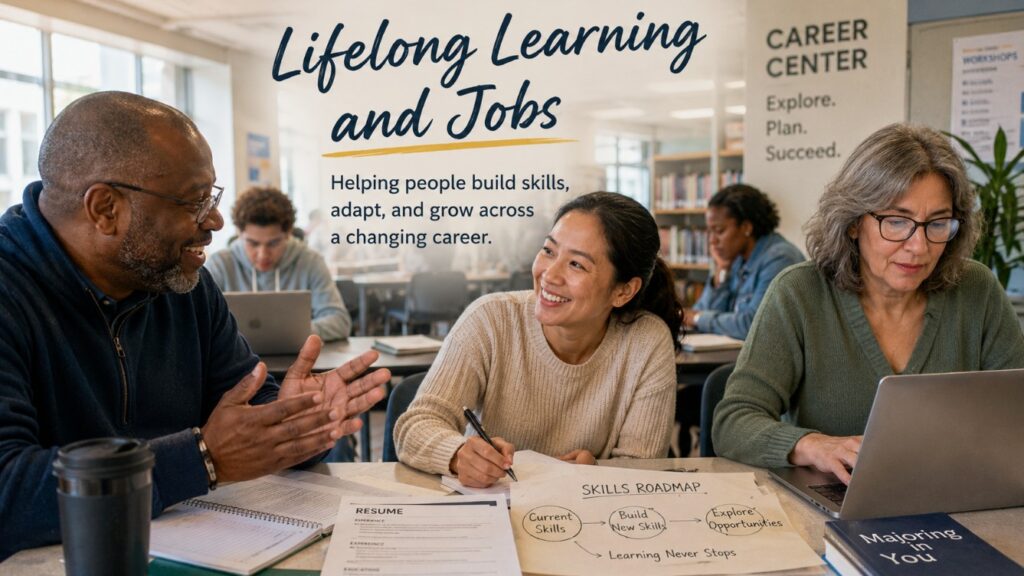
For decades, workforce development has focused on helping people prepare for employment. That usually means identifying a career goal, completing training, improving a résumé, preparing for interviews, and finding a job.
That work is still essential. But in a labor market shaped by artificial intelligence, automation, changing skill requirements, and less predictable career paths, helping someone find a job is no longer enough. Job seekers also need help learning how to keep learning.
That is where lifelong learning becomes important.
Lifelong learning means continuing to develop knowledge, skills, judgment, and understanding throughout life. It includes formal education and credentials, but it also happens through work, mentoring, observation, reading, experimentation, feedback, and reflection.
For job seekers, the main idea is simple: learning does not end when training is completed or when a job is found. Employment is another place where learning continues.
A lifelong learner pays attention to how an occupation is changing, which skills are becoming more valuable, and what they may need to learn next. This is different from simply earning a credential. A credential may help someone qualify for a job, but lifelong learning helps that person remain useful, adaptable, and prepared as the work changes.
Why this matters now
The traditional career model was fairly straightforward. People learned a skill, qualified for a job, and applied that knowledge for many years.
Today, the process is more continuous. People learn, begin working, encounter change, learn again, and adapt.
Consider a medical billing specialist who completes a certificate and finds employment. Several years later, the employer introduces AI-assisted claims-processing software. The job may not disappear, but the work changes. Routine tasks become more automated, while employees are expected to resolve unusual cases, identify errors, interpret regulations, communicate with providers, and oversee automated systems.
A worker who assumes learning ended when the certificate was earned may be caught off guard. A worker who expects the occupation to evolve is more likely to ask questions, seek additional training, and prepare for more complex responsibilities.
This is the practical value of lifelong learning. It helps people respond to change before they are forced to do so.
How workforce professionals can help
Workforce professionals can help job seekers look beyond the immediate opening. Instead of asking only, “What job can you get?” they can also ask, “How is this occupation changing?” or “What will you need to learn after you are hired?”
These conversations help job seekers think in terms of a career rather than a single placement. They also encourage people to pay attention to which tasks are becoming automated, which skills are becoming more important, and which human abilities employers continue to value.
Workforce professionals can also help job seekers understand that learning does not always require a lengthy academic program. Valuable skills can be developed through short courses, temporary assignments, volunteering, mentoring, online instruction, special projects, or problem-solving on the job.
The challenge is helping people recognize that learning and explain it clearly.
For example, instead of saying, “I helped customers,” a job seeker might describe how they resolved difficult problems, learned a new software system, trained coworkers, or improved a process.
Instead of simply saying, “I used AI,” the person could explain how they used it to research information, compare options, improve a draft, or complete work more efficiently while checking the accuracy of the results.
These examples show employers not only what the person has done, but also how the person learns and adapts.
Make learning part of the job search
The job search itself can become a learning process.
A job seeker might review several current job postings and look for skills that appear repeatedly. They can then compare those requirements with their own experience and identify one useful gap to address.
They can also talk with employers, current workers, or professional contacts and ask practical questions. What has changed most in this occupation? Which skills are difficult to find? What do successful new employees learn quickly? What makes someone valuable after the first six months?
These conversations often reveal information that does not appear in occupational reports or training catalogs. Workforce professionals can help job seekers interpret what they hear, avoid becoming overwhelmed, and focus on the next useful capability rather than trying to learn everything at once.
A simple process can help. Start with one important question, gather information from several sources, apply something through practice or a small project, reflect on what happened, and then document the result. That new skill can be added to a résumé, portfolio, interview example, or professional profile.
This turns learning into visible evidence.
A broader definition of success
Placement will remain an important measure of workforce success, but it is no longer a complete one.
A stronger outcome is whether the job seeker leaves the workforce system with a better understanding of how their occupation is changing, greater confidence in learning new tools, and a plan for continued growth after employment.
Workforce professionals do more than connect people with jobs. They help people understand the labor market, recognize their capabilities, build confidence, and prepare for change.
The workforce system of the past helped job seekers become qualified for a job. The workforce system now emerging must also help them remain adaptable throughout a career.
The job search may end. The need to learn does not.