


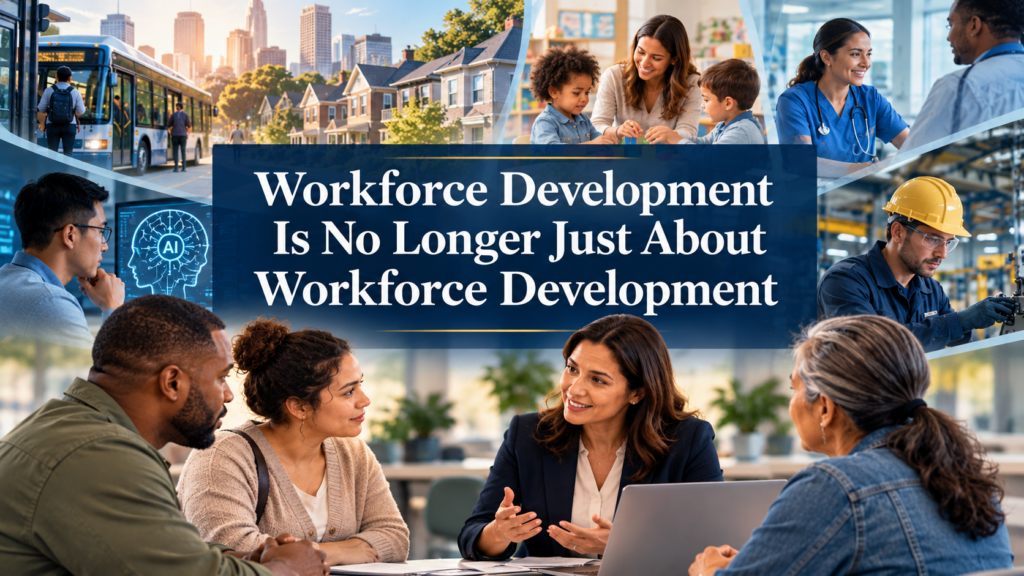
As economic, technological, and social challenges become increasingly interconnected, workforce professionals are finding that many of the issues shaping employment fall outside traditional training and placement programs.
For decades, workforce development has concentrated on a familiar challenge: helping individuals develop the skills employers need and connecting qualified workers with available jobs. Career counseling, employment assistance, occupational training, and employer services have remained central to this mission.
Those responsibilities remain essential. But the environment in which workforce professionals operate is changing.
Increasingly, the factors determining whether people can enter, remain in, or advance in the workforce have little to do with their qualifications. Housing costs, childcare availability, transportation, healthcare access, technological disruption, demographic changes, and economic development decisions are becoming inseparable from workforce outcomes.
Many workforce professionals already encounter these issues daily. What is changing is their growing importance and the need to understand how they interact.
This raises an important question for state workforce agencies, local workforce development boards, career counselors, employment specialists, and other workforce professionals:
How should the workforce system respond when some of the greatest obstacles to employment fall outside its traditional responsibilities?
The Workforce Problem May Not Be a Skills Problem
Consider a community experiencing difficulty recruiting healthcare workers. The initial response might be to expand training programs, increase enrollment in nursing and allied health occupations, or create new apprenticeship opportunities.
But what if the community is already producing qualified workers?
The actual problem could be that available housing is too expensive, childcare facilities cannot accommodate evening shifts, or transportation options do not connect residential neighborhoods with healthcare facilities.
Under these circumstances, additional training may increase the supply of qualified individuals without substantially improving employers’ ability to recruit and retain them.
Research increasingly illustrates the importance of looking beyond skills.
A June 2026 Federal Reserve Bank of Boston study examined how childcare availability and affordability affect employment among mothers with young children in New England. Researchers found that a $563 monthly reduction in childcare costs was associated with a 1.9-percentage-point increase in labor force participation.
The study illustrates a broader principle: employment decisions are influenced by circumstances that traditional workforce programs may not be designed to address.
For workforce professionals, identifying those circumstances can be as important as determining which skills an individual needs.
What This Means for Professionals Working Directly With Jobseekers
For career counselors, case managers, employment specialists, and other frontline professionals, these connections are especially important.
A jobseeker may have the qualifications, motivation, and experience necessary to obtain employment but still be unable to accept or retain a position.
A parent may decline a job because the available childcare costs more than the additional earnings. A qualified applicant may be unable to reach an industrial park without reliable transportation. An older worker may struggle to find employment because employers have changed their hiring practices. A young jobseeker may discover that traditional entry-level opportunities are disappearing or being restructured.
These situations illustrate why successful employment assistance requires more than identifying job openings and recommending training.
The Federal Reserve’s 2026 report on the economic well-being of U.S. households provides useful context. The report found that 42 percent of adults considered finding or keeping a job a financial concern in 2025, compared with 37 percent in 2024.
For frontline professionals, the practical challenge is determining what actually prevents a particular individual from succeeding.
Sometimes the answer will be additional education, improved job-search skills, or a different career pathway. In other cases, the more effective response may involve supportive services, an employer willing to adjust scheduling requirements, or coordination with another community organization.
But frontline professionals contribute something else that is equally valuable.
They often recognize emerging workforce problems before those problems become visible in labor market statistics.
When several jobseekers report that transportation costs are making employment impractical, that may indicate a broader community problem. When experienced workers repeatedly encounter new hiring requirements, it may signal changing employer expectations. When younger applicants struggle to obtain entry-level positions, it may suggest that established career pathways are changing.
Individually, these experiences may appear to be routine case-management challenges. Collectively, they can reveal emerging patterns that deserve attention from workforce leaders.
Creating simple ways for frontline staff to share recurring observations with supervisors, business services teams, and workforce boards could improve the system’s ability to recognize and respond to problems.
The goal is not to add another reporting burden. It is to make better use of information workforce professionals are already gathering through their daily interactions.
Economic Development and Workforce Development Are Becoming More Interdependent
Another example involves communities pursuing major economic development projects, including advanced manufacturing facilities, semiconductor plants, energy infrastructure, and data centers.
These projects are frequently announced with considerable attention to investment totals, construction employment, and projected permanent jobs.
Yet the actual workforce implications can be considerably more complicated.
A major data center, for example, may generate substantial construction employment over several years while requiring a much smaller permanent workforce after construction ends.
This raises questions that cannot be answered simply by establishing training programs.
How many jobs will remain in the community? Which skills developed during construction will transfer to other industries? Will local residents qualify for permanent positions? What happens to workers when temporary construction employment ends?
Perhaps most importantly, can communities convert a temporary period of economic activity into lasting employment opportunities?
These are simultaneously workforce development, economic development, infrastructure, and community planning questions.
Pennsylvania provides an example of how these issues are increasingly connected. Its 2026 Responsible Infrastructure Development (GRID) Standards address workforce and economic development alongside energy affordability, environmental protection, and community engagement.
For workforce professionals, the opportunity is to participate earlier in discussions about regional development, when decisions about hiring, training, infrastructure, and community investments are still being made.
Frontline professionals also have a role. Workers moving between industries, completing temporary assignments, or experiencing displacement need reliable information about which opportunities are likely to last and how their existing skills can transfer.
Artificial Intelligence Is Changing More Than Skill Requirements
Artificial intelligence presents another challenge that crosses traditional workforce boundaries.
Much of the workforce discussion surrounding AI has focused on potential job displacement and the need for new technical skills. These concerns remain relevant, but the implications are broader.
AI is changing how organizations structure work, distribute responsibilities, evaluate productivity, and determine which capabilities employees need.
According to the Federal Reserve’s 2026 Employment and Job Quality findings, one in four employed adults used generative AI at work during the preceding month in 2025. Among those users, 81 percent reported that it saved them time.
That finding raises questions extending well beyond whether employees need AI training.
If technology allows an organization to accomplish work with fewer labor hours, will employers reduce staffing, expand services, or redesign jobs? How will entry-level positions change when AI performs tasks traditionally assigned to less experienced workers? What opportunities might emerge for experienced workers who can combine professional judgment with AI capabilities?
For career counselors and employment specialists, these developments complicate career guidance.
A jobseeker may be preparing for an occupation whose responsibilities are changing faster than traditional occupational descriptions or training curricula. Someone with substantial experience may possess valuable transferable skills but lack familiarity with new technologies employers expect applicants to use.
Michigan’s AI Workforce Plan illustrates an approach that combines worker preparation, employer engagement, and workforce system modernization.
The challenge is not simply determining which AI courses to offer. It is understanding how technology is changing jobs, identifying which capabilities remain valuable, and helping workers adapt.
Demographic Change Creates Different Workforce Challenges
Population aging, retirement patterns, migration, and changes in labor force participation are also reshaping the workforce.
The Federal Reserve’s July 2026 Monetary Policy Report identified population aging and slower immigration as important factors contributing to reduced labor supply growth.
For some communities, the principal challenge may increasingly be the number of available workers rather than their qualifications.
A region experiencing population decline cannot necessarily solve its labor shortages through expanded occupational training alone. It may need strategies to attract and retain residents, improve housing availability, support older workers who wish to remain employed, or help employers adapt to a smaller labor force.
These developments also affect individual career decisions.
Older workers may need assistance identifying opportunities that accommodate changing preferences or physical capabilities. Younger workers may be considering whether their community offers sufficient long-term opportunities. Employers may need to reconsider recruiting practices that overlook qualified individuals who have traditionally faced barriers to employment.
The workforce implications of demographic change therefore extend from regional economic planning to individual career counseling.
From Program Delivery to Strategic Intelligence
These developments suggest an opportunity to strengthen the workforce system’s role as a source of practical intelligence.
State workforce agencies and local boards already collect extensive information about employment, training, occupational demand, and program outcomes. Career counselors, case managers, business services representatives, and training providers also encounter valuable information through their daily work.
Much of that information is never systematically examined for larger patterns.
Consider an employment specialist who notices that qualified applicants are repeatedly rejected for positions requiring experience with software that was not previously part of the occupation.
That observation could be an isolated occurrence. But if similar experiences are reported by other staff members, it may indicate that employer requirements are changing.
A business services representative could investigate whether those requirements are widespread. Training providers could examine whether existing curricula remain relevant. Workforce boards could assess whether the changes warrant adjustments to regional workforce strategies.
This is how individual observations can become useful intelligence.
The same approach applies to recurring childcare barriers, transportation problems, changing hiring practices, or unexpected patterns in jobseeker demand.
The essential step is distinguishing between an isolated problem and evidence of a larger change.
It also requires testing assumptions. An apparent skills shortage may actually reflect uncompetitive wages or undesirable schedules. A decline in job placements may reflect changing employer demand rather than declining program effectiveness.
Different causes require different solutions.
What Should Workforce Organizations Do Differently?
Responding to this broader environment does not necessarily require major organizational restructuring or new programs.
It may begin with practical changes in how workforce organizations observe, investigate, and respond to developments.
Broaden the information being monitored. Employment statistics and occupational projections remain essential, but workforce organizations should also pay attention to housing developments, infrastructure investments, demographic trends, technological changes, and public policy decisions that could affect employment.
Make better use of frontline observations. Career counselors, case managers, and employment specialists should have straightforward opportunities to communicate recurring problems and changing jobseeker experiences. Short discussions during existing staff meetings may be more useful than creating elaborate new reporting systems.
Investigate problems before selecting solutions. When employers report labor shortages or jobseekers struggle to find employment, determine whether the underlying problem involves skills, wages, hiring practices, geography, technology, or other factors.
Engage community partners earlier. Workforce organizations can contribute valuable information when communities consider major investments, transportation changes, housing developments, or economic initiatives. Early participation creates opportunities to influence outcomes rather than simply respond to their consequences.
Connect individual services with larger workforce strategies. Information gathered while assisting jobseekers can help identify community-wide challenges. At the same time, regional intelligence can improve the career guidance and employment assistance provided to individuals.
Focus on outcomes rather than activity alone. Training enrollments, credentials, and placements remain important measures. But employment retention, career advancement, labor force participation, and improved employer recruitment can provide additional insight into whether workforce interventions are addressing the underlying problem.
A Broader Mission, Not an Unlimited One
None of this suggests that workforce agencies should become responsible for solving housing shortages, operating transportation systems, managing childcare programs, or directing economic development policy.
Such an expansion would be unrealistic and could divert limited resources from essential workforce services.
Instead, the opportunity is to become more effective at identifying how these issues affect employment and helping the appropriate organizations coordinate their responses.
Workforce professionals occupy an unusual position within communities. They interact with jobseekers, employers, educational institutions, government agencies, and community organizations.
Few other professions have the same combination of access to individual employment experiences and knowledge of broader labor market conditions.
That perspective can provide substantial value when it is used not only to deliver services but also to recognize emerging challenges and inform better decisions.
The Opportunity Ahead
Workforce development has never operated independently of the broader economy. What is changing is the extent to which employment outcomes are influenced by developments outside traditional workforce programs.
Technological change, demographic shifts, infrastructure investment, housing affordability, childcare availability, and community conditions are becoming more closely connected.
For professionals working directly with jobseekers, this means understanding the circumstances that influence an individual’s ability to obtain and retain employment.
For workforce boards and state agencies, it means recognizing how these individual experiences connect to broader economic and community challenges.
For the workforce system as a whole, it creates an opportunity to become more valuable by identifying emerging problems, interpreting their implications, and coordinating practical responses.
The workforce system does not need to become responsible for everything that affects employment.
But it can become much more effective by helping communities understand how those factors fit together.
Perhaps the most important question for workforce professionals is no longer simply, “What training does this person or community need?” It is, “What is preventing people from succeeding in the workforce, and what can we do, together with others, to change that?”
Sources and Further Reading
- Federal Reserve Bank of Boston (June 2026). How Do the Availability and Cost of Childcare Influence Women’s Labor Market Outcomes in New England? Research examining childcare costs, availability, and labor force participation.
- Federal Reserve Board (May 2026). Economic Well-Being of U.S. Households in 2025. National findings on employment, household finances, childcare, housing, and economic pressures.
- Federal Reserve Board (May 2026). Employment and Job Quality. Findings on employment conditions, job quality, and generative AI use at work.
- Michigan Department of Labor and Economic Opportunity (May 2026). Michigan AI Workforce Plan: New Data and State’s Progress. State efforts to prepare workers, employers, and workforce systems for AI-related changes.
- Federal Reserve Board (July 2026). Monetary Policy Report. Analysis of labor market conditions, demographics, and labor supply.
- Pennsylvania Department of Community and Economic Development (2026). Governor’s Responsible Infrastructure Development Standards. An example of integrating workforce development, economic development, infrastructure, and community considerations.