


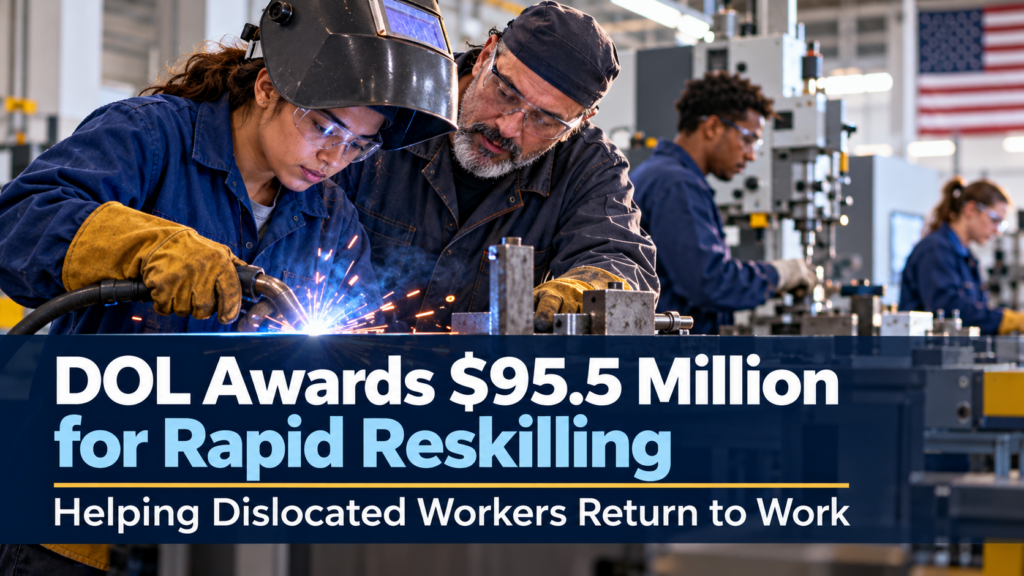
New Department of Labor funding supports 20 projects across 17 states, with an emphasis on moving dislocated workers into high-demand jobs within six months.
The U.S. Department of Labor announced on October 19, 2026, that it has awarded $95.5 million in grants to help workers affected by layoffs acquire new skills and return to employment. Beyond the funding itself, the initiative offers an important indication of federal workforce development priorities: shorter training periods, faster transitions into employment, and closer alignment with industries experiencing growing demand for skilled workers.
Administered by the Employment and Training Administration (ETA), the Rapid Reskill Dislocated Worker Grants will support 20 projects across 17 states. The initiative focuses on connecting dislocated workers with opportunities in domestic manufacturing, aerospace, energy production, construction, and other growing industries.
For workforce development professionals, the announcement raises an important question: How can workforce systems help displaced workers transition into new occupations more quickly without sacrificing the quality and sustainability of employment?
A Different Emphasis on Reemployment
Traditional dislocated worker programs often combine career counseling, assessments, occupational training, and supportive services to help workers return to employment. These services remain important, but the new grants place particular emphasis on accelerating the process.
The Department of Labor has established a goal of moving participants into paid employment, Registered Apprenticeships, or other structured, paid on-the-job training within six months of enrollment.
The projects are expected to assess workers’ existing skills, identify transferable capabilities, and provide short-term, intensive training that leads to industry-recognized credentials.
This approach recognizes that many displaced workers already possess valuable occupational skills and experience. Rather than beginning an entirely new educational pathway, workers may be able to transition into related occupations by acquiring a relatively limited set of additional competencies.
For example, a manufacturing worker affected by a plant closure may already possess technical, mechanical, or quality-control skills applicable to aerospace production, energy infrastructure, or advanced manufacturing. The challenge is identifying the skills that transfer and determining what additional preparation employers actually require.
The underlying opportunity is to make reskilling more targeted, practical, and responsive to actual job openings.
Employers Become Central to the Process
One of the most consequential aspects of the initiative is its emphasis on industries with significant demand for workers.
Training programs have historically faced a persistent challenge: participants can successfully complete training without necessarily finding employment in the occupations for which they were prepared.
A more demand-driven approach begins with employers and the positions they need to fill. Workforce agencies, workforce boards, training providers, and employers can then work backward to determine which skills are essential and how workers can acquire them efficiently.
This could encourage greater use of employer-designed training, customized instruction, Registered Apprenticeships, and work-based learning.
However, employer participation will be critical. Identifying a growing industry is not the same as identifying specific employers prepared to hire workers who complete training.
Successful implementation will require workforce organizations to establish meaningful relationships with employers and regularly verify that training programs reflect changing hiring requirements.
What the Grants Mean for State and Local Workforce Systems
The grants are particularly relevant to state workforce agencies and local workforce development boards responsible for responding to layoffs and economic transitions.
The awards include state agencies, local workforce organizations, and nonprofit or specialized training providers.
Among the recipients are the Michigan Department of Labor and Economic Opportunity, Florida Department of Commerce, Washington Employment Security Department, Capital Area Workforce Development Board in North Carolina, and Workforce Alliance in Connecticut.
Several organizations outside traditional state government structures also received awards, including Per Scholas and Pursuit Transformation Company in New York, along with Adaptive Construction Solutions and SER-Jobs for Progress of the Texas Gulf Coast in Texas.
The variety of recipients creates an opportunity to examine different approaches to rapid reemployment.
For state agencies, the initiative may provide useful models for coordinating workforce programs, identifying industries with growing labor demand, and supporting regional responses to layoffs.
For local workforce boards, it presents opportunities to strengthen employer relationships, improve skills assessments, and work with education and training providers to develop shorter pathways into employment.
It also raises questions about how these new approaches might be incorporated into ongoing Workforce Innovation and Opportunity Act (WIOA) services after grant funding ends.
The Importance of Transferable Skills
Perhaps the most interesting opportunity involves identifying skills workers already possess.
A worker’s occupation does not necessarily provide a complete picture of their capabilities. Experience in manufacturing, logistics, construction, maintenance, and other industries can develop technical and problem-solving skills relevant to occupations outside a worker’s previous industry.
Recognizing these connections could reduce unnecessary training and help workers identify opportunities they might otherwise overlook.
For workforce professionals, this suggests an increasing need for sophisticated skills assessments, better occupational information, and stronger knowledge of employer requirements.
Technology, including artificial intelligence, may eventually help make these assessments more effective by identifying relationships between previous experience, skill requirements, and emerging occupations.
The opportunity is not simply to recommend different occupations. It is to identify realistic pathways that workers can complete within a reasonable period and that lead to actual employment.
Measuring Results Beyond Training Completion
The six-month employment objective also draws attention to how workforce development programs measure success.
Training enrollment and credential completion remain useful indicators, but they do not necessarily demonstrate that workers have achieved meaningful economic advancement.
The more consequential questions concern how quickly participants obtain employment, whether the jobs provide adequate wages, and whether workers remain employed over time.
A rapid transition into employment is valuable, but speed alone should not determine success.
Workforce organizations will need to balance immediate reemployment objectives with longer-term career prospects. A short training program that leads to a sustainable occupation may provide greater value than either prolonged training without clear employment opportunities or quick placement into work with limited advancement potential.
The new grants offer an opportunity to examine these tradeoffs and identify approaches that produce measurable improvements in workers’ employment outcomes.
An Opportunity to Learn from 20 Different Models
An important feature of the initiative is the Department of Labor’s expectation that grant recipients develop and share innovative approaches.
With 20 projects operating across different states, industries, and workforce environments, the grants could produce useful evidence about what works in rapid reskilling.
Some projects may focus on transferable skills and accelerated credentials. Others may rely more heavily on apprenticeships, employer partnerships, or structured work-based learning.
The Department of Labor’s announcement does not provide sufficient detail to compare the individual project designs. Those distinctions should become clearer as implementation proceeds.
For the broader workforce development community, monitoring the projects could be valuable even for organizations that did not receive funding.
State agencies and workforce boards might examine which approaches reduce the time between displacement and reemployment, which employer partnerships produce sustained hiring, and which training models can be replicated without substantial additional resources.
Equally important will be understanding where the models encounter difficulties.
Not all displaced workers have skills that transfer readily to growing occupations. Geographic mobility, transportation, childcare, wages, and differences between local labor markets can complicate even well-designed training initiatives.
Learning from these challenges will be as important as documenting successful outcomes.
A Broader Question for Workforce Development
The $95.5 million investment comes at a time when economic and technological changes are creating new demands for workforce adaptability.
Artificial intelligence, automation, changing energy markets, and shifts in manufacturing are altering occupational requirements, even as employers in some industries continue struggling to find qualified workers.
These developments increase the importance of helping workers move between occupations and industries throughout their careers.
For workforce development professionals, the central challenge may increasingly be less about creating additional training programs and more about making career transitions easier, faster, and more reliable.
The Rapid Reskill Dislocated Worker Grants represent one federal effort to address that challenge.
Whether the initiative produces lasting improvements will depend on implementation, employer engagement, participant outcomes, and the ability to apply successful approaches beyond the original grant recipients.
For state workforce agencies, local workforce boards, and other workforce organizations, these projects are worth following closely.
The larger opportunity is not simply to train displaced workers faster. It is to build workforce systems that can recognize existing skills, anticipate changing employer needs, and help people navigate economic transitions more effectively.
Source: U.S. Department of Labor, Employment and Training Administration, October 19, 2026. US Department of Labor awards $95.5 million in grants to support innovative programs for reskilling and reemploying dislocated workers.