


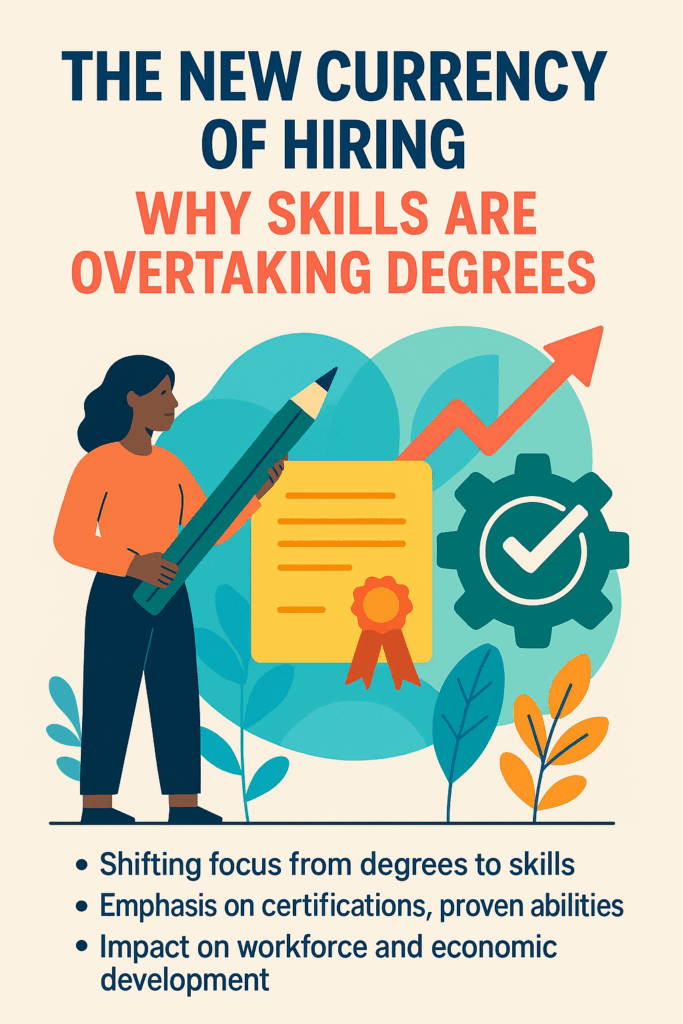
For decades, a college degree served as a universal signal of employability. It appeared on job descriptions as a default requirement—even when the actual work did not require the knowledge gained in a formal classroom setting. Today, that dynamic is changing rapidly.
Across industries, employers are moving away from degree-based hiring toward a skills-first approach. They’re asking not, Where did this person go to school? but rather, Can they do the job?
This shift is not merely a hiring trend—it represents a broader transformation in how talent is evaluated, how individuals access opportunity, and how regions position themselves for economic growth.
Why Skills Are Gaining Ground
Several factors are driving the move toward skills-based hiring:
-
Fast-changing technology and industry needs require more agile, job-ready talent
-
Many degree holders lack the specific skills employers are seeking
-
Growing recognition of the value in nontraditional career pathways—including certifications, apprenticeships, military service, and on-the-job experience
As a result, job postings that once listed a four-year degree as a requirement now emphasize demonstrated competencies, certifications, and even portfolio work.
This evolution is prompting serious questions for workforce development and economic strategy professionals alike: Are current systems built to support this new reality?
Implications for Workforce Development
Workforce development organizations now face both opportunity and responsibility.
A skills-first hiring environment allows greater access for workers who have historically been excluded from quality employment—those without formal degrees but with valuable real-world experience. But the shift also demands a rethinking of how training and career services are delivered.
Key areas of focus include:
-
Helping individuals identify and articulate their skills, especially those gained outside of formal education
-
Aligning training programs with actual employer needs, not outdated job titles
-
Strengthening employer partnerships to define in-demand skills more clearly
-
Building trust in nontraditional credentials and developing ways to validate them
Workforce systems that succeed in this environment will be those that can evolve quickly, communicate value effectively, and measure progress by more than job placement numbers alone.
Economic Development Depends on Workforce Readiness
The relationship between workforce and economic development has never been more direct.
Today, a region’s ability to attract and retain employers is often determined by the strength and adaptability of its talent pool. Companies evaluating where to expand or invest are asking: Can this region deliver a workforce with the skills we need—not just today, but in five years?
For economic developers, this makes the skills-based hiring shift a strategic issue. Strong workforce pipelines are now a top economic asset. The ability to rapidly develop and signal local skills is essential not only to business attraction, but also to long-term regional competitiveness.
Moving from Silos to Systems
The skills-first movement creates an opening to build better systems across traditional boundaries. It calls for collaboration among:
-
Workforce boards
-
Community colleges and training providers
-
K–12 systems
-
Employers and chambers of commerce
-
State and local economic development agencies
Together, these stakeholders can create more transparent, equitable, and effective talent pipelines—systems that recognize the full range of human potential and respond to the realities of today’s labor market.
A Call to Action
As the skills-first economy takes hold, workforce and economic development professionals are uniquely positioned to lead.
This leadership will require:
-
Rethinking success metrics beyond employment rates
-
Investing in tools that surface and validate skills
-
Supporting lifelong career navigation and reskilling pathways
-
Ensuring that policy and funding structures encourage innovation
The shift away from degrees as default credentials is not just a hiring reform. It is an opportunity to build a workforce system that is more inclusive, more resilient, and more aligned with the future of work.
Communities that embrace this transition—not just in principle, but in practice—will be the ones best prepared for the challenges and opportunities ahead.