


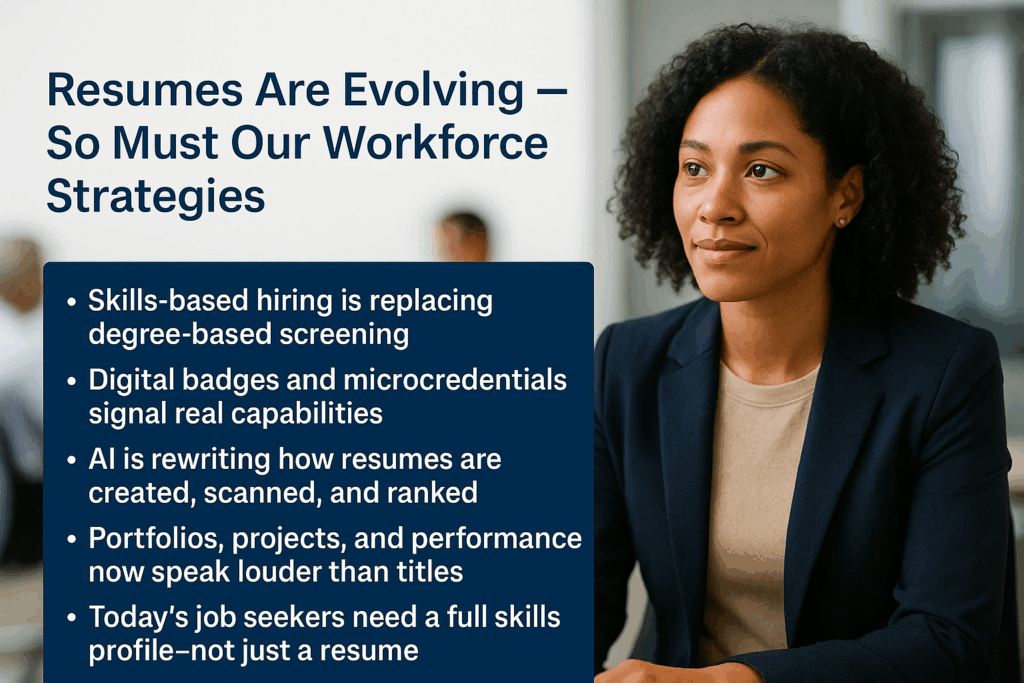
For decades, the resume has been the go-to tool for jobseekers. And to be fair, it’s still important. But in today’s job market, it’s no longer the only thing that matters—and often, it’s not the most important.
Employers today want more than just a list of past jobs. They’re looking for skills, adaptability, and proof of what someone can actually do. That shift changes how we prepare jobseekers—and it calls for a fresh strategy from workforce professionals.
🔹 What’s Changing—and What the Numbers Say
🧠 Skills Are Replacing Degrees
A growing number of employers are removing degree requirements from job postings.
According to a 2023 report by Indeed and Glassdoor, 55% of employers said they had removed degree requirements for at least some roles, and this number is expected to increase.
That’s a major shift—and a big opportunity for jobseekers with the right capabilities.
🧾 Microcredentials Are on the Rise
Digital badges, short courses, and industry-recognized microcredentials are becoming part of mainstream hiring.
The World Economic Forum reports that by 2027, half of all workers will need reskilling, and short, stackable credentials are seen as one of the most scalable solutions.
🤖 AI Is Reshaping Resumes
Employers are using AI to screen candidates through applicant tracking systems (ATS), and jobseekers are increasingly using AI to write and tailor resumes.
A 2023 ResumeBuilder.com survey found that 46% of jobseekers have used AI tools like ChatGPT to help write their resumes—and most reported receiving more interviews as a result.
This means workforce professionals need to help clients use these tools effectively—and responsibly.
🎓 Employers Want Proof, Not Just Paper
In a digital-first world, portfolios, project summaries, and video intros are gaining traction across industries—even in fields that used to rely heavily on resumes alone.
LinkedIn data shows that candidates who add portfolio content to their profile are 71% more likely to get interview requests than those who don’t.
✅ How Workforce Professionals Can Stay Ahead
You don’t need to overhaul your entire approach—but you do need to adapt it.
Here’s how you can make an immediate impact:
-
Shift to skills-first coaching. Help jobseekers identify, articulate, and document the skills they bring—especially transferable ones.
-
Introduce credentialing options. Encourage jobseekers to earn short, job-aligned certifications that enhance their credibility.
-
Show how to use AI the right way. AI-assisted resumes are here to stay, but human insight still matters. Help jobseekers avoid robotic, overly generic documents.
-
Support personal branding. Encourage digital presence—whether it’s a LinkedIn profile, a simple portfolio, or a short bio video.
-
Keep teaching resume fundamentals. The resume isn’t going away, but it’s now just one piece of a larger career toolkit.
-
Point clients to trusted training platforms. www.workforcelearn.com offers flexible, job-relevant online courses that help jobseekers build both confidence and skills.
🔔 Let’s Move Forward—Together
The job market is changing fast, but the mission remains the same: help people find meaningful work and lasting opportunity.
Now’s the time to evolve our strategies. That means:
-
Emphasizing skills over job titles
-
Promoting real, hands-on learning
-
Equipping jobseekers with a complete, modern career profile
Let’s give jobseekers more than a resume. Let’s help them show what they’re capable of—and get hired for it.