


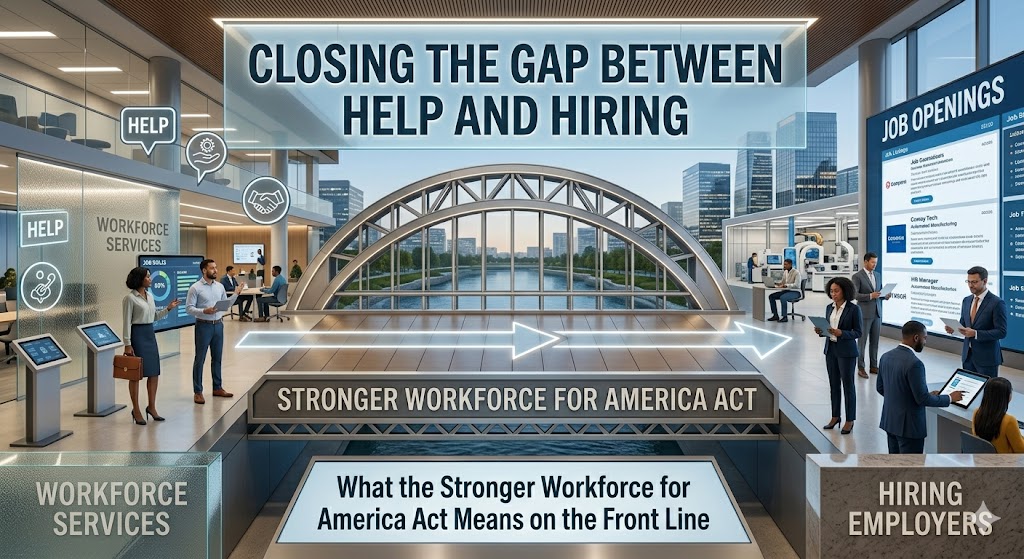
A person walks into a workforce center—maybe recently laid off, maybe stuck in a job with no future, maybe simply unsure what comes next. You ask the familiar questions about their background, their goals, and what they need right now. But underneath that conversation is the real challenge: connecting them to something that actually leads somewhere.
That gap between services and employment is what the Stronger Workforce for America Act H.R. 6655 is trying to close. Full text:
A shift toward job‑linked training
The Act pushes the workforce system to focus more directly on the fastest, most reliable path to a real job. And in most cases, that means training—specifically training tied to actual hiring demand. This changes the tone of the conversation. Instead of starting with “What services should we provide?”, the system is being nudged toward “What skills will get this person hired—and how quickly can we get them there?”
It’s a more direct, more practical approach. And it brings the system closer to what jobseekers often assume it already does: connect them to training that leads to real employment.
Employers shaping the starting point
Another big shift is who gets to shape the training itself. Instead of building programs and then asking employers if they’re interested, the Act encourages employers to be part of the design from the beginning. Their open positions, skill gaps, and credential expectations become the foundation for what gets funded.
This moves employer engagement from outreach to alignment and makes the path from training to employment more predictable.
Supportive services still matter
Even with more emphasis on training, the realities jobseekers face don’t magically disappear. People still struggle with transportation, childcare, housing instability, or simply the confidence to stick with a program long enough to finish it. The Act doesn’t remove these challenges. It just raises the stakes for addressing them, because training only works if people can complete it.
The system isn’t just about getting someone into a program—it’s about getting them through it.
What changes for workforce professionals
The Act doesn’t flip the system overnight, but it does set a clearer direction. On the front line, you may find yourself:
- Moving people into training more quickly
- Asking more directly what job a program leads to
- Spending more time working with employers
- Being asked to show clearer, more measurable outcomes
The mission becomes more focused, but the expectations become sharper.
A system that works the way people assume it does
Stepping back, the Stronger Workforce for America Act is trying to bring the system closer to the promise people believe it already makes: if you show up ready to work, the system will help you build the skills you need and connect you to a job that actually moves your life forward. The truth has always been more complicated—full of barriers, mismatched programs, and pathways that don’t always lead where people hoped.
This legislation doesn’t magically erase those challenges, but it does tighten the focus on what matters most: training that leads to real jobs, employers who help shape the path, and support that makes completion possible. It shifts the work toward clarity, toward alignment, and toward outcomes that genuinely change someone’s trajectory.
And it raises the stakes in that moment when a jobseeker looks at you and asks, “What should I do next?” Because now, the expectation isn’t just that you’ll offer options—it’s that you’ll help them choose a path that leads somewhere real, somewhere tangible, somewhere better.