


For the past several years, workforce professionals have been hearing increasingly dramatic predictions about what artificial intelligence will do to jobs.
The U.S. Bureau of Labor Statistics is now offering a more measured way to look at the question.
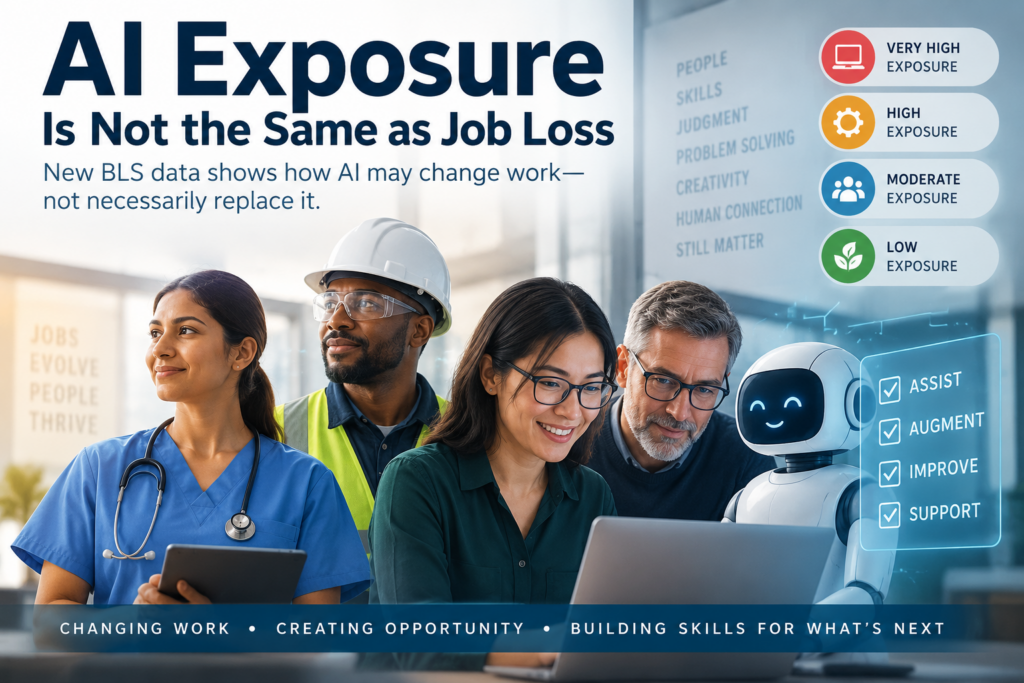
Along with its new employment projections for 2025 through 2035, released August 27, BLS introduced something it has never provided before: an AI exposure category for every detailed occupation in its projections. Occupations are classified as having low, moderate, high or very high exposure to artificial intelligence.
The important word is exposure.
BLS is not predicting that occupations with high AI exposure will disappear. In fact, the agency specifically cautions against interpreting the categories that way. High exposure does not mean employment will decline, and low exposure does not mean a job is protected from technological change. The categories also do not predict wages, productivity, adoption of AI or the probability that workers will be replaced.
Instead, BLS is asking a more practical question: How much of the work performed in an occupation could potentially be assisted or performed by today’s AI technologies?
That produces some interesting results.
Web developers, customer service representatives and personal financial advisors are among the occupations BLS identifies as having very high relative AI exposure. Firefighters, dental hygienists, and maids and housekeeping cleaners are examples of occupations with relatively low exposure.
The distinction matters for workforce development.
Consider a customer service representative. AI may be capable of answering routine questions, summarizing customer histories, drafting responses and helping employees find information more quickly. That does not necessarily mean the occupation disappears. It could mean that the tasks within the occupation change.
The same may happen across many professional and administrative jobs.
Workers may spend less time producing first drafts, searching for information, preparing routine reports or answering predictable questions. They may spend more time reviewing AI-generated work, dealing with unusual situations, exercising judgment and communicating with people.
That suggests a different workforce question than simply asking, “Which jobs will AI eliminate?”
A better question may be: How will the work inside these jobs change?
The broader BLS projections reinforce the need for that distinction.
BLS projects the U.S. economy will add about 5.9 million jobs between 2025 and 2035, an increase of 3.5 percent. Healthcare and social assistance alone is expected to add more than 2.2 million jobs, accounting for roughly 37 percent of projected job growth. Utilities is projected to be the fastest-growing major industry sector, partly because of increased electricity demand that includes power needed for artificial intelligence.
So AI is not appearing in the projections simply as a force that removes jobs. It can reduce demand for some tasks while increasing demand elsewhere.
That is important for career counseling and training.
A job seeker considering an occupation with high AI exposure should not necessarily be discouraged from entering it. The more useful conversation may be about how that occupation is likely to evolve and what capabilities will become more valuable as AI becomes part of the work.
Can the worker use AI effectively? Can they recognize when its answer is wrong? Can they ask better questions, evaluate information, solve unusual problems and exercise judgment when there is no obvious answer?
Those abilities may become increasingly important precisely in occupations where AI exposure is highest.
There is another reason for caution. BLS acknowledges that AI is changing so quickly that its new categories cannot capture everything that may happen. The measures draw heavily on research into large language models and on evidence that already predates today’s technology. BLS also notes that the categories do not distinguish between AI that automates work and AI that augments workers.
That may ultimately be the most important distinction of all.
For workforce professionals, the new BLS data provides something better than another prediction about how many jobs AI will destroy.
It gives us a starting point for looking occupation by occupation and asking what may actually change.
And that may move the conversation from “Will AI take this job?” to the considerably more useful question:
“What will someone need to know how to do differently to succeed in this job?”
BLS released the 2025–2035 Employment Projections and its new Artificial Intelligence Exposure Categories on August 27, 2026.