


If you have been following the labor market over the past year, you may have noticed something interesting.
No matter what is happening elsewhere in the economy, one sector keeps showing up in the job growth numbers: healthcare.
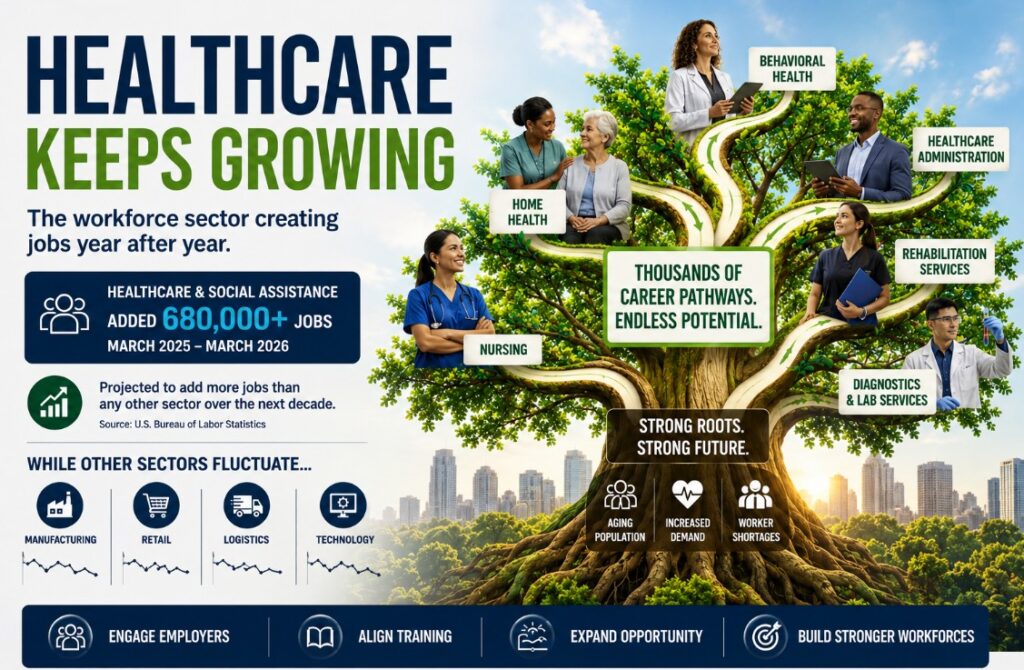
The latest employment reports once again show healthcare among the leading sources of new jobs. In fact, healthcare and social assistance added more than 680,000 jobs between March 2025 and March 2026, making it one of the strongest growth sectors in the economy. Recent long-term projections also indicate that healthcare and social assistance are expected to add more jobs than any other sector over the next decade.
For workforce professionals, this raises an important question:
Are we paying enough attention to the sector that keeps creating opportunities?
For years, workforce discussions have focused on manufacturing, technology, logistics, and other high-profile industries. These sectors remain important. However, healthcare continues to quietly generate jobs at a scale that few industries can match.
The reasons are not difficult to understand.
America’s population is aging. People are living longer. Demand for healthcare services continues to grow. At the same time, many healthcare occupations are experiencing shortages, creating ongoing demand for workers across a wide range of skill levels.
What makes this particularly important for workforce professionals is the diversity of opportunities available.
When many people think of healthcare careers, they immediately think of doctors and nurses. Yet some of the fastest-growing occupations include nurse practitioners, medical and health services managers, physical therapist assistants, home health aides, and numerous support positions that require varying levels of education and training.
This creates opportunities for job seekers from many different backgrounds.
A young person entering the workforce, a dislocated worker seeking a new career, a veteran transitioning to civilian employment, or an incumbent worker looking to advance may all find viable pathways within the healthcare sector.
Implications for Workforce Professionals
The continued growth of healthcare suggests several opportunities for workforce organizations.
First, examine whether local healthcare employers are sufficiently engaged in workforce planning discussions. If healthcare is one of the largest sources of job growth in your region, it should likely be one of the largest sources of employer engagement.
Second, review training and career pathway offerings. Are programs aligned with occupations experiencing sustained demand, or are they focused primarily on industries that receive more attention than actual hiring?
Third, help job seekers understand the breadth of healthcare careers available. Many individuals are unaware of the wide range of roles that exist beyond traditional clinical occupations.
Finally, think beyond immediate openings. Long-term workforce development is often about identifying trends before they become urgent. Healthcare’s growth is not a short-term phenomenon. Current projections suggest it will remain one of the strongest sources of employment growth well into the next decade.
Looking Beyond the Headline
The signal here is not simply that healthcare is hiring.
The signal is that one sector continues to create jobs year after year while many workforce conversations remain focused elsewhere.
For workforce professionals, that raises a valuable question:
If healthcare is likely to generate more jobs than any other sector over the next decade, are we investing enough attention, partnerships, and resources to help workers access those opportunities?
Sometimes the most important workforce trends are not the newest ones.
They are the ones that continue to grow right in front of us.