


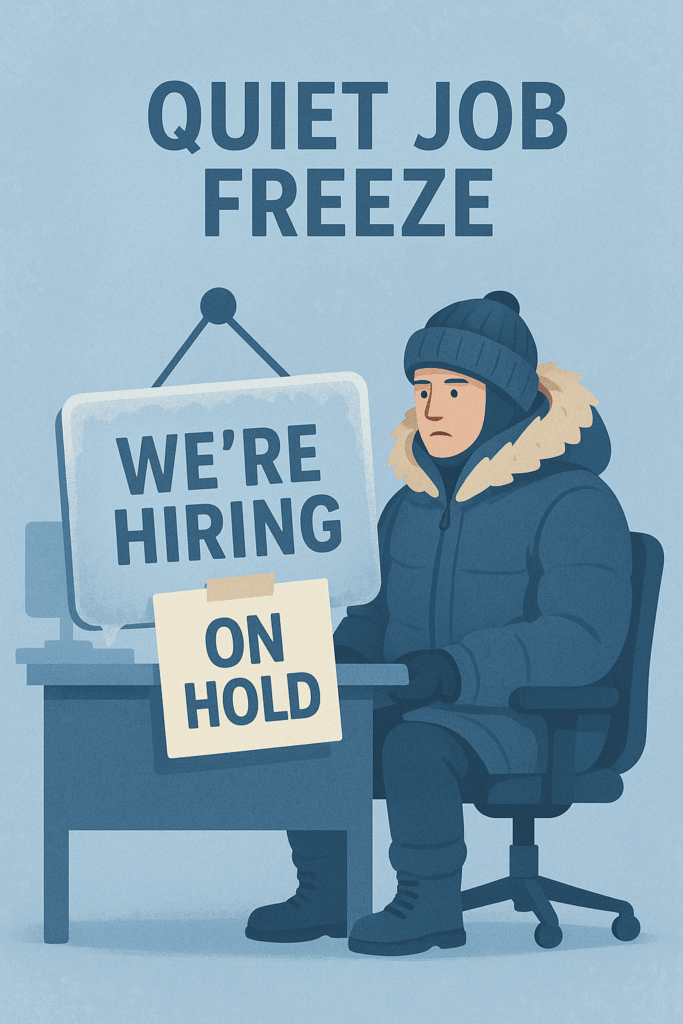
If you’ve been watching the labor market closely, you’ve probably noticed something unusual. Job postings are down. Hiring decisions are taking longer. But layoffs are minimal, unemployment remains low, and the broader economy isn’t flashing recession signs.
This slowdown-without-a-downturn is what many analysts are calling a Quiet Freeze. And it’s one of the most important patterns for workforce professionals to understand right now.
What is the Quiet Freeze?
The Quiet Freeze is a period when companies hit “pause” on expansion, not because business is collapsing, but because they’re being cautious.
- Employers aren’t cutting staff
- They’re not rushing to hire either
- They’re simply waiting.
From the outside, that creates a labor market that feels indecisive—neither strong nor weak, just… stalled.
What’s causing it?
Several forces are converging:
1. Employers are digesting the hiring boom of 2021–2022.
Many organizations expanded quickly and now want to grow into their existing teams before adding more people.
2. AI is prompting companies to revisit job design.
Before posting a role, leaders are asking whether it should be restructured, automated, or combined with another function. This reflection delays hiring.
3. Cost discipline has returned.
Even without a recession, many organizations want to slow spending. The easiest expense to pause is new hiring.
4. Worker turnover is down.
People aren’t quitting at the same pace as previous years. Fewer exits mean fewer openings.
Those forces combined give us a slower, more cautious labor market—without the typical signs of trouble.
Why this matters for workforce development
This is where your work becomes especially important.
Job seekers will misread the slowdown.
They may internalize the slowness and assume something is wrong with their background or approach. They need clarity and reassurance about what’s actually happening.
Employers will become more selective.
Hiring processes lengthen. Skill alignment becomes more important. “Good enough” isn’t enough in a cautious market.
Job boards will tell an incomplete story.
The real picture comes from direct conversations with employers—not from posting patterns alone.
What can workforce professionals do right now?
1. Strengthen employer conversations.
Ask employers the kinds of questions that reveal the real story:
-
Is this a full hiring freeze or a slow-down?
-
What skill gaps are blocking progress?
-
What conditions would reopen this role?
-
Are you rethinking positions because of technology or restructuring?
These conversations help you stay aligned with employers’ real needs.
2. Help job seekers focus on precision.
In a Quiet Freeze, success isn’t about volume.
It’s about alignment.
A single well-targeted application can outperform dozens of generic ones.
3. Encourage strategic upskilling.
When employers get cautious, the hiring threshold moves upward. Short-term credentials can push candidates over that line.
4. Translate the moment clearly.
Workforce professionals play a critical role in helping people understand what’s happening.
Job seekers need context.
Employers need reassurance that you understand their constraints.
Your teams need a shared interpretation of the market.
Why this moment is so important
The Quiet Freeze is not a crisis. It’s a recalibration.
Employers are rethinking how work is structured, how technology fits in, and what skills really matter. This moment creates opportunity for workforce professionals to lead—to guide job seekers thoughtfully, to strengthen employer partnerships, and to help communities navigate uncertainty with confidence.
When hiring picks up again, the professionals who understood and prepared for this moment will be the ones best positioned to support both sides of the labor market.