


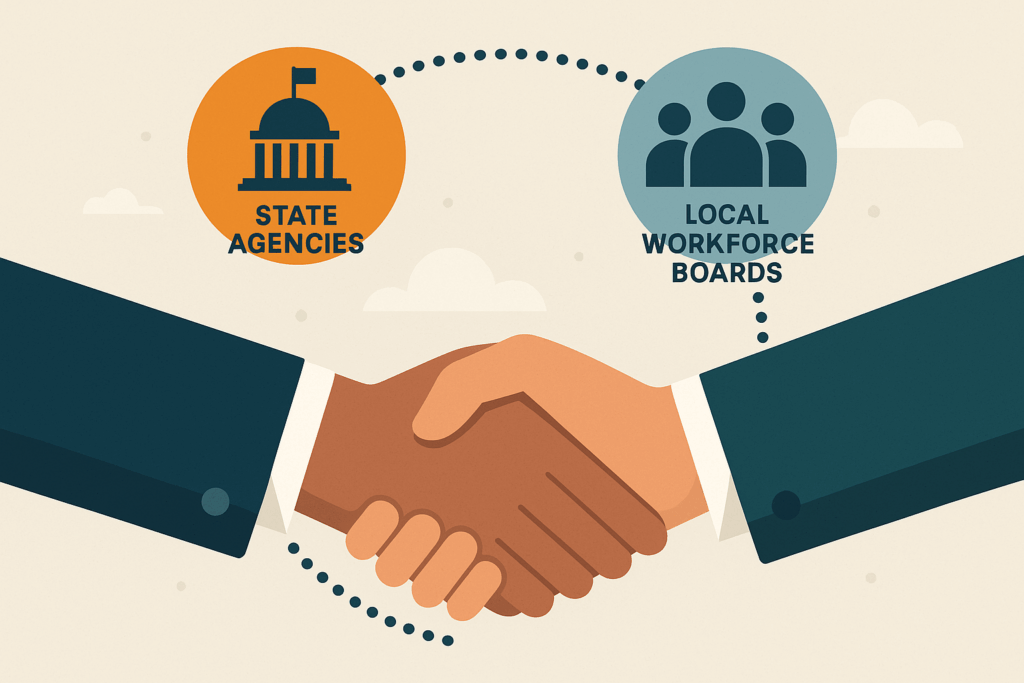
When Congress passed the Workforce Innovation and Opportunity Act (WIOA), it didn’t create two separate organizations; it mandated a single, unified system. The reality, however, is that the crucial link between state-level policy and local-level execution is often the system’s weakest point.
The challenge is simple: State agencies set the strategic direction and manage the large-scale resources, while Local Workforce Development Boards (LWDBs) execute that strategy on the ground, engaging employers and serving jobseekers. When this partnership is a mere transaction, the system stalls. When it’s a true collaboration, the entire workforce ecosystem thrives.
This is not just about compliance; it’s about delivering better results for the people and businesses in our communities. So, what does a truly successful state-local partnership look like, and what are the immediate, tangible benefits?
The Unbeatable Edge: Seven Outcomes of True Collaboration
When state and local partners move beyond compliance and actively collaborate, they unlock powerful advantages that directly benefit workers, businesses, and taxpayers.
1. Unified Employer Engagement and Sector Strategy
Employers don’t want to navigate a maze of local programs. A unified system offers a single, coherent front. States can launch a high-level initiative—like a statewide push for healthcare training—while local boards ensure that training is immediately relevant to specific hospitals and clinics in their area. Businesses get consistent talent, and workers get clear career pathways.
2. Strategic Resource Deployment
Collaboration eliminates the costly trap of duplication. The State can invest in high-cost, high-impact infrastructure—such as a modern data analytics platform or a statewide credential registry. Local boards then leverage that infrastructure, tailoring its use to their community’s unique needs. Funding stretches further, maximizing return on investment.
3. Seamless Customer Experience for Jobseekers
When policy and practice align, jobseekers encounter a system that is intentional and easy to navigate. They aren’t bounced between programs or left with gaps in their career journey. Services are lined up, creating clear and supportive career pathways from entry-level to advanced skills.
4. Robust Data Integrity and Performance
WIOA performance targets demand accuracy. State agencies develop the data systems; local boards are responsible for the integrity of the data being input. Working together ensures that state-captured data accurately reflects local progress, making federal performance goals realistic and achievable. This shared ownership leads to better outcomes and credible reporting.
5. Accelerating Local Innovation Statewide
Some of the most effective solutions begin as local experiments. A successful reentry program in one city, or an employer-driven apprenticeship model in one county, can be tracked by the state, analyzed, and quickly scaled to other regions, turning local success into statewide impact.
6. A Powerful, Credible Policy Voice
To secure continued funding and legislative support, the workforce system must demonstrate results. When State agencies present data-driven evidence of impact, and Local Boards provide the powerful human stories behind those numbers, they speak with a single, clear, and highly credible voice to governors and legislators.
7. Deeper Community and Economic Impact
Workforce development must be integrated into the broader economic picture. Collaboration ensures state strategies align with economic development agencies, while local boards connect with community colleges, CBOs, and regional planning initiatives. This alignment drives regional growth, not just individual job placement.
Three Immediate Steps to Fortify the Partnership
Collaboration is an active decision, not a passive requirement. State agencies and local boards can take these three practical steps right now to deepen their strategic partnership:
1. Mandate Joint Planning and Problem-Solving
Move beyond compliance check-ins. Establish standing, recurring sessions where state leadership and local board chairs/staff tackle emerging issues—like a new sector strategy or a performance challenge—together. This creates a space for mutual accountability and shared ownership.
2. Invest in Radical Data Transparency
States must open up their dashboards and reporting tools for local use, allowing boards to access timely data to make decisions. In return, local boards should actively share granular employer intelligence and jobseeker insights that make statewide data meaningful and actionable.
3. Establish a “Pilot-to-Scale” Pipeline
States should actively encourage LWDBs to test innovative concepts—from new digital tools to apprenticeship models—by offering small innovation grants. Crucially, the State must commit to tracking the results and providing the resources to scale successful local pilots statewide.
The Takeaway: Beyond Agencies, Beyond Boards
WIOA did not create a “command and control” structure or a collection of “independent operators.” It created an essential partnership, recognizing that the best policy is informed by the best practice, and the best practice is guided by clear policy.
The goal isn’t just to make the agencies and boards work well together. The goal is to make the workforce system greater than the sum of its parts. Because ultimately, the success of this partnership is measured in the lives of the people who find good careers, the businesses that find the talent they need, and the communities that build a stronger future.