


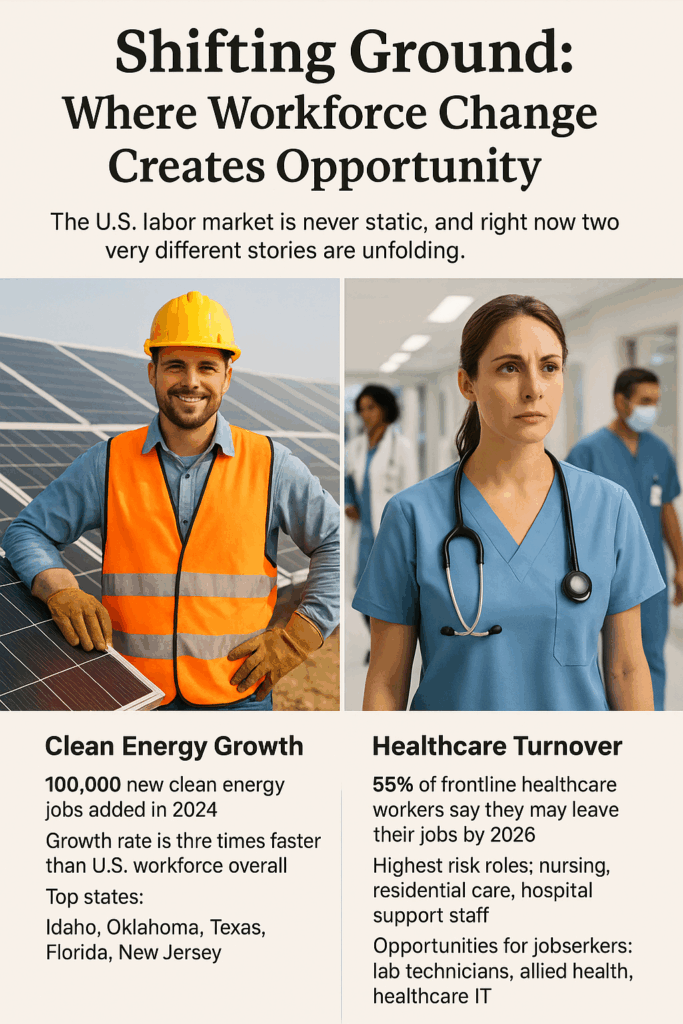
The U.S. labor market is never static, and right now two very different stories are unfolding. On one side, clean energy is surging ahead, creating jobs at three times the pace of the overall economy. On the other, healthcare is showing signs of strain, with more than half of frontline workers saying they may leave their jobs in the next year.
For workforce development professionals, these trends aren’t just headlines. They are signals of where opportunities may open for jobseekers and where our systems need to adapt quickly.
Clean Energy: A Fast-Growing Sector
Clean energy is no longer a niche industry — it’s one of the nation’s fastest-growing job creators. Last year alone, more than 100,000 clean energy jobs were added, spanning renewable power generation, battery storage, electric vehicle infrastructure, and energy efficiency. States like Idaho, Oklahoma, Texas, Florida, and New Jersey are seeing some of the sharpest growth.
What makes this especially important for the workforce community is that many of these jobs don’t require a four-year degree. Instead, they call for targeted training, technical skills, and certifications that can be delivered through community colleges, apprenticeship programs, and local workforce boards. That means the sector offers a clear on-ramp for workers looking to step into well-paying, future-focused careers.
For more detail, see the Clean Jobs America report from Environmental Entrepreneurs (E2): Clean Energy Jobs Report.
Healthcare: A Sector Under Pressure
At the same time, healthcare is facing a very different challenge. A recent survey found that 55% of frontline workers — including nurses, aides, and technicians — are considering leaving their jobs by 2026. Stress, burnout, and staffing shortages are driving people out of roles that are already difficult to fill.
This isn’t only a crisis for hospitals. It reaches across the healthcare system — residential care facilities, community health centers, and clinics are all feeling the pressure. And while physicians often get the spotlight, many of the most urgent openings are in support positions such as lab technicians, billing specialists, and healthcare IT.
For deeper insights, see the Harris Poll findings: Healthcare Workforce Survey.
Quick Facts: Workforce Shifts to Watch
Clean Energy Growth
-
100,000 new clean energy jobs added in 2024
-
Growth rate is three times faster than the U.S. workforce overall
-
Top states: Idaho, Oklahoma, Texas, Florida, New Jersey
Healthcare Turnover
-
55% of frontline healthcare workers say they may leave their jobs by 2026
-
Highest risk roles: nursing, residential care, hospital support staff
-
Opportunities for jobseekers: lab technicians, allied health, healthcare IT
How Workforce Professionals Can Respond
Both clean energy and healthcare will need support from the workforce system, but in very different ways. Here are a few priorities to consider:
-
Invest in training pipelines: Fast-track certifications in healthcare support and technical credentials in clean energy can help jobseekers step into roles quickly.
-
Promote transferable skills: Workers from customer service, IT, or logistics can pivot into these fields with targeted upskilling.
-
Build strong partnerships: Collaboration with industry associations, employers, and community colleges is key to aligning training with local demand.
-
Support retention as well as recruitment: In healthcare, helping employers build career ladders and mentorship opportunities is just as important as training new entrants.
Advice for Workforce Professionals
-
Highlight training pipelines that provide quick entry into both clean energy and healthcare support roles.
-
Match transferable skills from other industries to these sectors to expand the pool of candidates.
-
Encourage employers to invest in career development and workplace supports that reduce turnover, especially in healthcare.
Final Thought
The picture is mixed: one sector racing to hire, another struggling to keep its people. But for workforce development professionals, both point to the same opportunity — helping jobseekers connect to pathways that are in demand and guiding employers through the transitions ahead.
By aligning training, partnerships, and support systems, we can make sure the rapid growth in clean energy translates into lasting careers, and the pressure in healthcare doesn’t become a crisis but a chance to reimagine how we support and retain essential workers.