


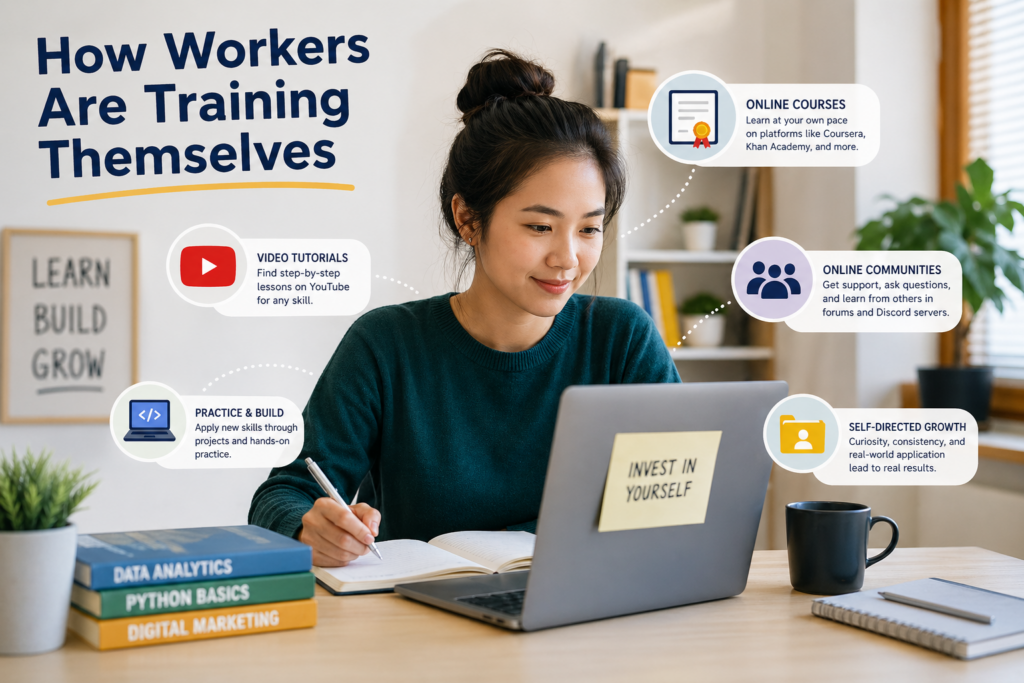
Workers aren’t waiting for programs to catch up. Right now, millions of people are quietly building new skills on their own time, using tools that are mostly free, mostly online, and mostly invisible to the workforce development system. As practitioners, that matters — because it’s changing who walks through your door and what they actually need from you.
Here’s what’s happening, and what to do about it.
HOW PEOPLE ARE TRAINING THEMSELVES
YouTube has become the world’s largest free vocational school. Workers are searching for exactly what they need — Excel tutorials, intro to coding, how to wire a circuit — and finding high-quality instruction available at any hour, completely free. Platforms like Coursera, Google Career Certificates, Khan Academy, and freeCodeCamp offer structured courses in everything from data analytics to project management, often at little or no cost. Many allow learners to go at their own pace, which matters enormously for people juggling jobs and families.
Beyond formal courses, online communities are doing something programs rarely manage: sustained peer support. Discord servers and Reddit communities dedicated to specific fields have hundreds of thousands of members who answer each other’s questions in real time. A person learning cybersecurity can join a community today and still have mentors and peers three years from now.
And then there’s the learning no one tracks at all — the administrative assistant automating her own spreadsheets, the retail manager reading every piece of industry research he can find, the nurse who taught herself data analysis to understand her unit’s outcomes. It’s real, it’s widespread, and it shows up eventually in what people can do — long after the learning itself is finished and unrecorded.
WHAT THIS MEANS FOR YOUR WORK WITH JOBSEEKERS
The self-taught jobseeker is one of the most common people sitting across from you right now — and one of the most underserved. They may have completed a full online curriculum, built portfolio projects, and spent months in an active learning community, but their resume still looks like a gap. Your first job with this person is not to enroll them in training. It’s to find out what they already know.
Change your intake questions. Ask not just what they’ve done but what they’ve been learning, what they figured out on their own, what they can show you. Help them translate self-directed work into resume language — a completed Google Data Analytics certificate is a credential, a personal project built during independent study is a portfolio item. Both belong on a resume, and most jobseekers won’t put them there unless someone tells them to.
For jobseekers who haven’t started yet, free platforms can serve as a low-stakes on-ramp before formal enrollment. But “go explore some stuff online” isn’t a strategy. Set a specific experiment — three hours on a specific platform, check in next week — and follow up. The accountability of knowing someone cares is often the difference between a person who opens the platform and one who doesn’t.
WHAT THIS MEANS FOR YOUR WORK WITH EMPLOYERS
Most employers say they hire for skills. Most still screen resumes by degree and job title. That gap is where your best self-directed candidates get filtered out.
Your job is translation. You are not asking employers to lower standards — you are asking them to look for evidence of competence in more places. That conversation is easier when you come with a specific candidate and a specific example of what they can do. Lead with what they built, not how they learned it. “She built a working inventory system in Excel as part of her independent study” lands differently than “she took some online courses.”
Brief employers on what self-directed credentials actually mean. A CompTIA Security+ certification requires real, rigorous study to pass. An AWS Cloud Practitioner cert is recognized across the industry. Most hiring managers don’t know this. Tell them. And ask employers to consider adding a skills demonstration option to their process — a short task or portfolio review alongside the resume screen. Frame it as getting better signal, not lowering the bar.
WHAT THIS MEANS FOR YOUR WORK WITH PLATFORMS
Most workforce organizations have referral relationships with colleges and training providers. Very few have any relationship with the platforms where their participants are actually learning. That’s a gap worth closing.
Several platforms have workforce-specific programs worth knowing. Google’s Grow with Google initiative connects certificate completers to employers. Coursera has workforce partnerships that can unlock free access for certain populations. LinkedIn Learning is available free through many public library systems — an immediate, no-barrier resource you can hand to any jobseeker today. Map what your participants are using, then build those platforms into your referral toolkit alongside traditional providers.
THE BOTTOM LINE
Self-directed learning is not a threat to workforce programs. It’s context for them. The workers who are already learning on their own need help validating what they know and making it visible to employers. The ones who haven’t started need the right nudge and the right resources. Employers need a partner who can help them see competence in new places. And platforms need workforce professionals who can connect their tools to the people who need them most.
That’s the job. This is just the current version of it.