


Workforce development professionals are under pressure to deliver results in a labor market defined by shortages, rapid change, and employer frustration. At the same time, one of the most capable and available segments of the workforce—older workers—often remains underutilized.
Recent research from AARP, using LinkedIn labor market data, reinforces what many practitioners already see on the ground: workers age 50 and older are staying in the labor force longer, actively upskilling, and delivering strong retention outcomes for employers. The challenge is not motivation or ability. The challenge is alignment—between jobseekers, workforce systems, and employer hiring practices.
Helping older workers find jobs requires moving beyond generic advice and focusing on practical interventions that remove friction and create confidence on both sides of the hiring equation.
Why Older Workers Matter More Than Ever
According to the AARP–LinkedIn research, more than 85 percent of workers age 50 and older hired in mid-2024 were still with their employer one year later, compared with roughly 71 percent of younger workers. In a labor market where turnover is costly and disruptive, this stability is a competitive advantage.
The same research shows that older workers are closing the technology skills gap faster than many assume. Over the past several years, growth in “disruptive” and digital skills among older professionals has outpaced that of younger workers, and participation in job-related training has nearly reached parity across age groups.
For workforce development systems, this data reframes older workers not as a population in need of accommodation, but as a strategic asset—if systems are designed to support successful connection to employment.
Start With How Older Workers Present Themselves
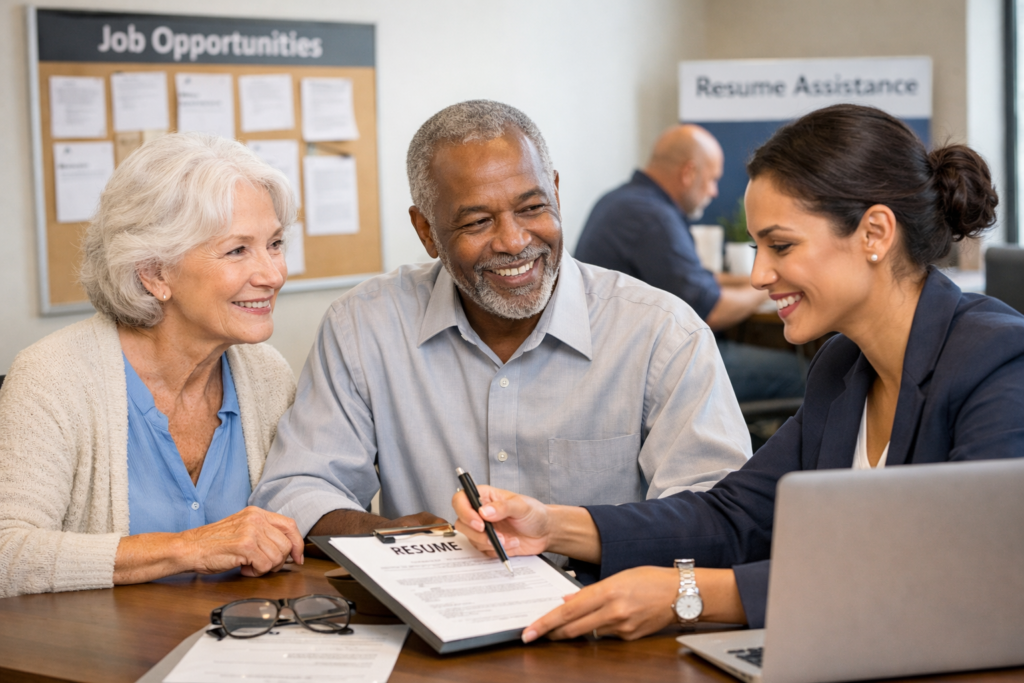
One of the most immediate barriers older jobseekers face is not a lack of skills, but how those skills are communicated. Résumés and online profiles often unintentionally signal age in ways that trigger unconscious bias long before an interview.
Workforce professionals can make a significant impact by helping older workers modernize how they present experience. This usually means focusing on the most recent 10 to 15 years, emphasizing outcomes and problem-solving rather than tenure, using current job titles and industry language, and clearly listing modern tools, platforms, or technologies. The goal is not to hide experience, but to translate it into terms that resonate with today’s hiring managers and applicant tracking systems.
Focus Training on Clear Labor Market Signals
Older workers are often willing to learn, but they are understandably selective about training that does not clearly lead to employment. Workforce programs are most effective when training is short, targeted, and explicitly tied to employer demand.
Credentials and skill development in areas such as digital tools, project coordination, data literacy, compliance, customer experience, or supervisory skills tend to generate stronger outcomes when employers are involved in validating relevance. When workforce professionals can say, “This is what gets you interviewed,” participation and completion improve significantly.
Reframe Employer Conversations Around Business Value
Employer engagement is a critical leverage point. Age bias often shows up indirectly, through language about “culture fit,” “energy,” or “adaptability.” Workforce professionals can help shift these conversations by reframing older workers as a retention and reliability strategy.
Data on reduced turnover, faster ramp-up, leadership experience, and team stability resonate with employers when presented in business terms. Rather than leading with equity arguments alone, anchoring conversations in cost savings, continuity, and performance often opens doors that remain closed when age is discussed explicitly.
Reduce Risk Through Flexible Placement Models
Perceived risk is a major barrier to hiring older workers, especially for employers accustomed to rapid turnover. Workforce systems can lower that barrier through trial-to-hire arrangements, paid work experiences, project-based roles, or contract-to-permanent placements.
These models allow employers to see performance quickly while giving older workers a chance to demonstrate relevance in real work settings. In many cases, short engagements convert to permanent roles once value is evident.
Activate Networks With Intention
Older workers typically have deep professional networks, but many are unfamiliar with how modern job searches rely on targeted referrals rather than broad outreach. Workforce professionals can support jobseekers by coaching them to reconnect strategically—through informational interviews, industry-specific introductions, alumni connections, and employer-facilitated networking opportunities.
Structured networking events tied to specific roles or sectors are often more effective than open-ended job fairs, particularly for experienced workers.
Address Confidence and Hiring Realities Head-On
Extended job searches, age bias, and rapid workplace change can erode confidence even among highly capable professionals. Career coaching that normalizes today’s hiring environment, helps jobseekers develop concise narratives about their value, and prepares them for modern interview formats can make a measurable difference.
This is not about lowering expectations. It is about helping older workers navigate a system that looks very different from the one they entered years ago.
Treat Age Inclusion as a System Design Issue
Older workers face the greatest challenges when workforce systems are built around assumptions that fit only younger, first-time jobseekers—long training pipelines, entry-level wages, rigid schedules, or digital-only access points.
Programs that offer flexible pacing, hybrid delivery, rapid re-entry pathways, and employer-validated shortcuts tend to serve older workers better while also improving outcomes for many other participants.
The Bottom Line for Workforce Development
Helping older workers find jobs is not about special treatment or parallel systems. It is about aligning presentation, training, employer incentives, and placement design with how hiring actually works today.
When workforce development systems do this well, older workers often become some of the most successful, stable, and impactful placements they make—benefiting employers, communities, and the workforce system itself.
Full Research Report:
The Untapped Value Older Workers Bring to the Multigenerational Workforce
https://www.aarp.org/content/dam/aarp/research/topics/work-finances-retirement/employers-workforce/multigenerational-workforce-linkedin.doi.10.26419-2fres.01026.001.pdf